Traffic Calming and Speed Limit Reduction

Share Traffic Calming and Speed Limit Reduction on Facebook Share Traffic Calming and Speed Limit Reduction on Twitter Share Traffic Calming and Speed Limit Reduction on Linkedin Email Traffic Calming and Speed Limit Reduction link

Whitehorse is a community that values healthy and safe mobility for all, regardless of how we move. The City recently adopted a new Transportation Master Plan, which establishes a long-term vision for transportation in Whitehorse, and a target to eliminate fatalities and serious injuries from Whitehorse’s transportation network by 2040.The City and its partners are committed to this goal, and traffic calming measures and speed limit reductions are among the tools being used to achieve it.

What is Traffic Calming?

Traffic calming uses engineering solutions and urban design to slow vehicle speeds, reduce traffic volumes, and enhance safety for

Whitehorse is a community that values healthy and safe mobility for all, regardless of how we move. The City recently adopted a new Transportation Master Plan, which establishes a long-term vision for transportation in Whitehorse, and a target to eliminate fatalities and serious injuries from Whitehorse’s transportation network by 2040.The City and its partners are committed to this goal, and traffic calming measures and speed limit reductions are among the tools being used to achieve it.

What is Traffic Calming?

Traffic calming uses engineering solutions and urban design to slow vehicle speeds, reduce traffic volumes, and enhance safety for all road users. Implementing traffic calming measures can involve physical changes to the street design (e.g. speed bumps) and regulatory changes (e.g. turn restrictions).The goal of traffic calming is to improve safety and neighbourhood livability by mitigating the negative impacts of speeding and shortcutting, while still maintaining reasonable access for residents, public transit, snow clearing, and emergency services.

Every year, the City implements a series of seasonal and permanent traffic calming measures across Whitehorse to reduce vehicle speeds and create safer streets for everyone. While traffic calming is a great tool for reducing motor vehicle speeds and volumes, the City also uses education, enforcement, and other engineering projects to improve road safety. When assessing where traffic calming may be needed, the City will also consider if other solutions may be more appropriate for a particular neighbourhood.

The City has developed a Traffic Calming Framework that outlines a process for residents to request traffic calming. Requests for traffic calming can be made through a new tool and are evaluated on a yearly basis. Requests received by September 30th of each year will be considered for implementation in the following construction season.

Click here to request traffic calming.

Kid Alert Sign Distribution

The City is distributing Kid Alert signs you can place in your front yard to remind drivers to slow down and drive safely. Click here to request a Kid Alert Sign for free.

Speed Limit Reduction

Speed limits for all streets in the City are shown in the Traffic Bylaw. The City periodically reviews speed limits across the City to improve safety and ensure that speed limits match the surrounding context.

In 2022, the City reduced speed limits on all streets downtown to 40 kilometres per hour. In 2025, the City reduced speed limits to 40 km/h on all streets in residential neighbourhoods throughout Whitehorse where the speed limit was previously 50 km/hr. In addition, the speed limit on Hamilton Boulevard between the roundabout at McIntyre Drive and the south end of Falcon Drive was reduced to 50 km/hr.

  • 2026 Neighbourhood Traffic Calming Plan

    Share 2026 Neighbourhood Traffic Calming Plan on Facebook Share 2026 Neighbourhood Traffic Calming Plan on Twitter Share 2026 Neighbourhood Traffic Calming Plan on Linkedin Email 2026 Neighbourhood Traffic Calming Plan link

    The 2026 locations were identified by analyzing areas of concern highlighted in the Transportation Master Plan, the Speed Limit Reduction Report and by residents. Speed and traffic data were collected to validate these concerns and to help determine the most appropriate calming measures for each location.

    YEAR-ROUND MEASURES

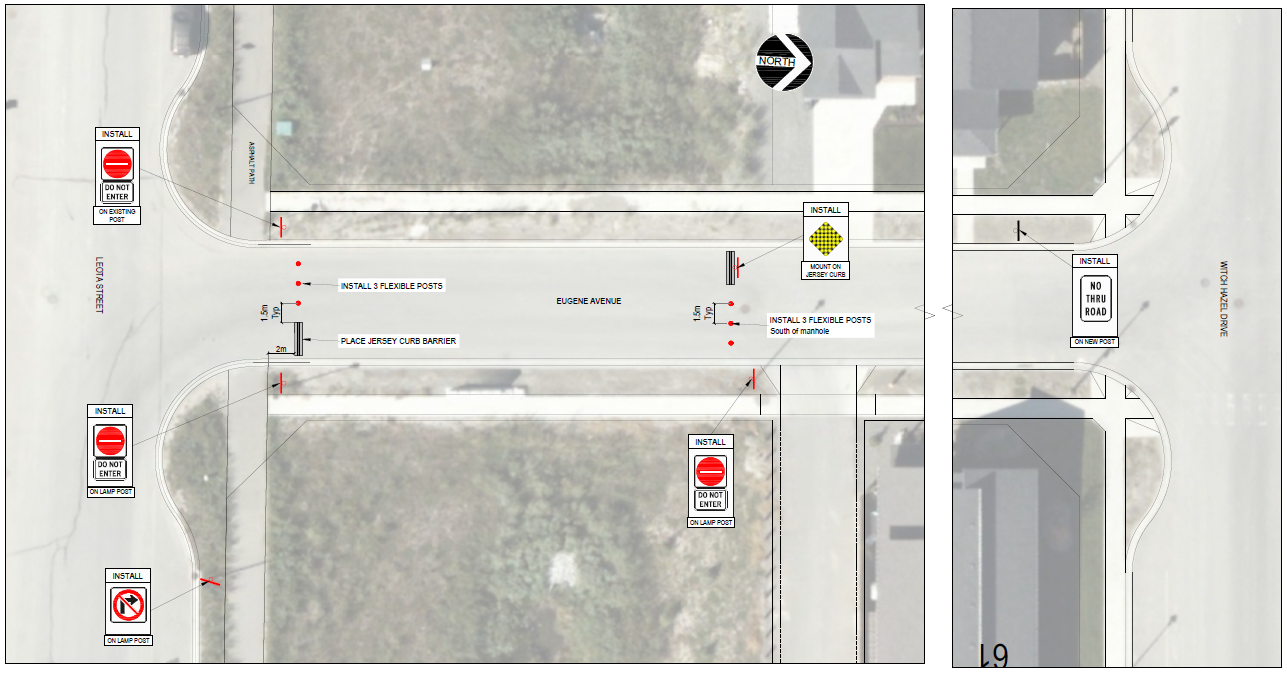
    Eugene Avenue South End Closure

    Eugene Avenue is a local road in Whistle Bend. Local roads are designed to allow residents to access their homes with minimal through traffic. Due to the roadway design of Whistle Bend, many drivers shortcut through Eugene Avenue, causing discomfort and safety concerns for residents. The City is expecting the closure to take place in early June and remain in place year-round.

    • Engineering assessments and public engagement were completed in 2024 to develop a traffic calming plan for Eugene Avenue. The final report is available here. The recommendation is to implement a cul-de-sac at the south end of Eugene Avenue.
    • The City temporary closure was piloted for 2 months last summer.
    • The design includes knock-down bollards for emergency access and jersey barriers.
    • Data collection is ongoing for Leota Street and Witch Hazel Drive.
    Pedestrian crossing refuges

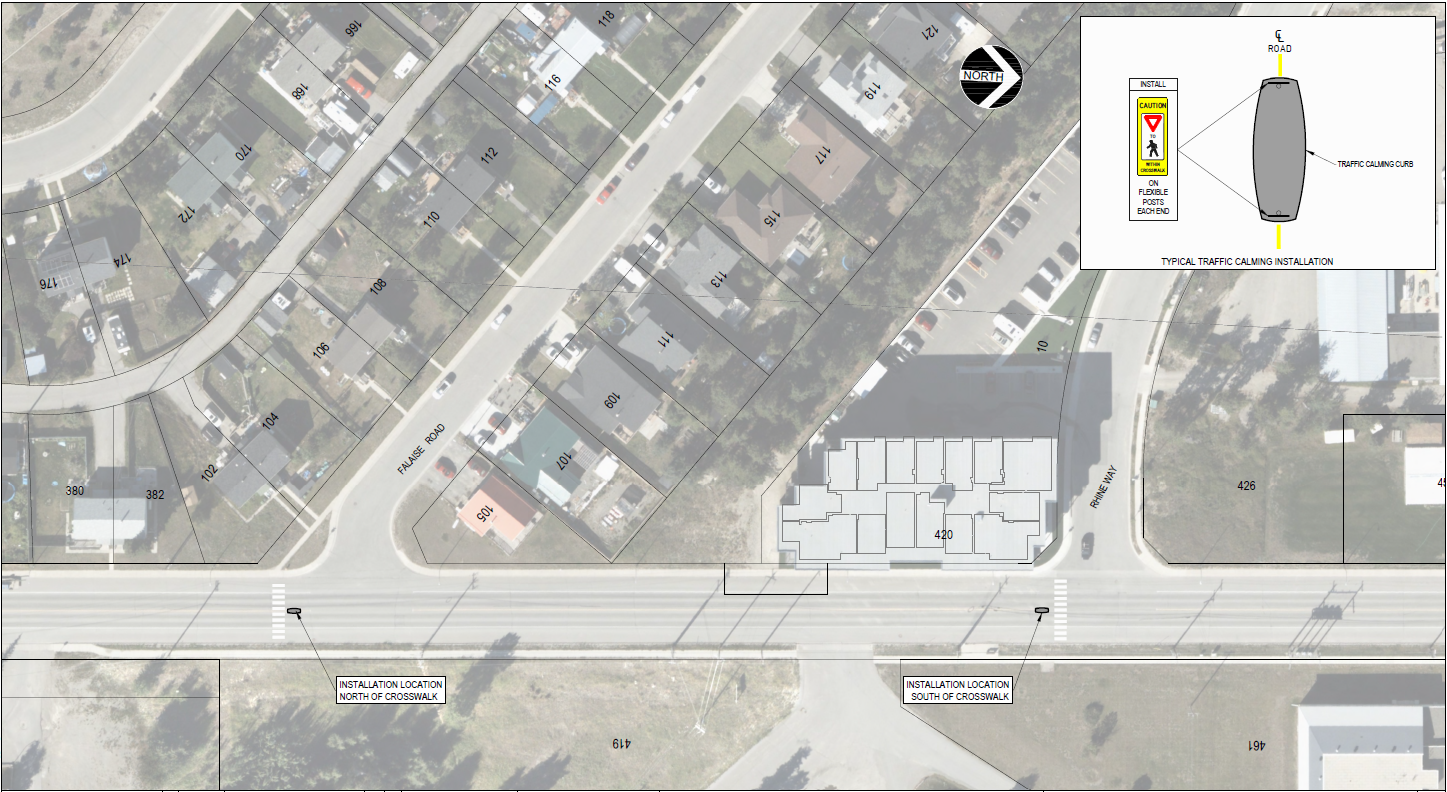
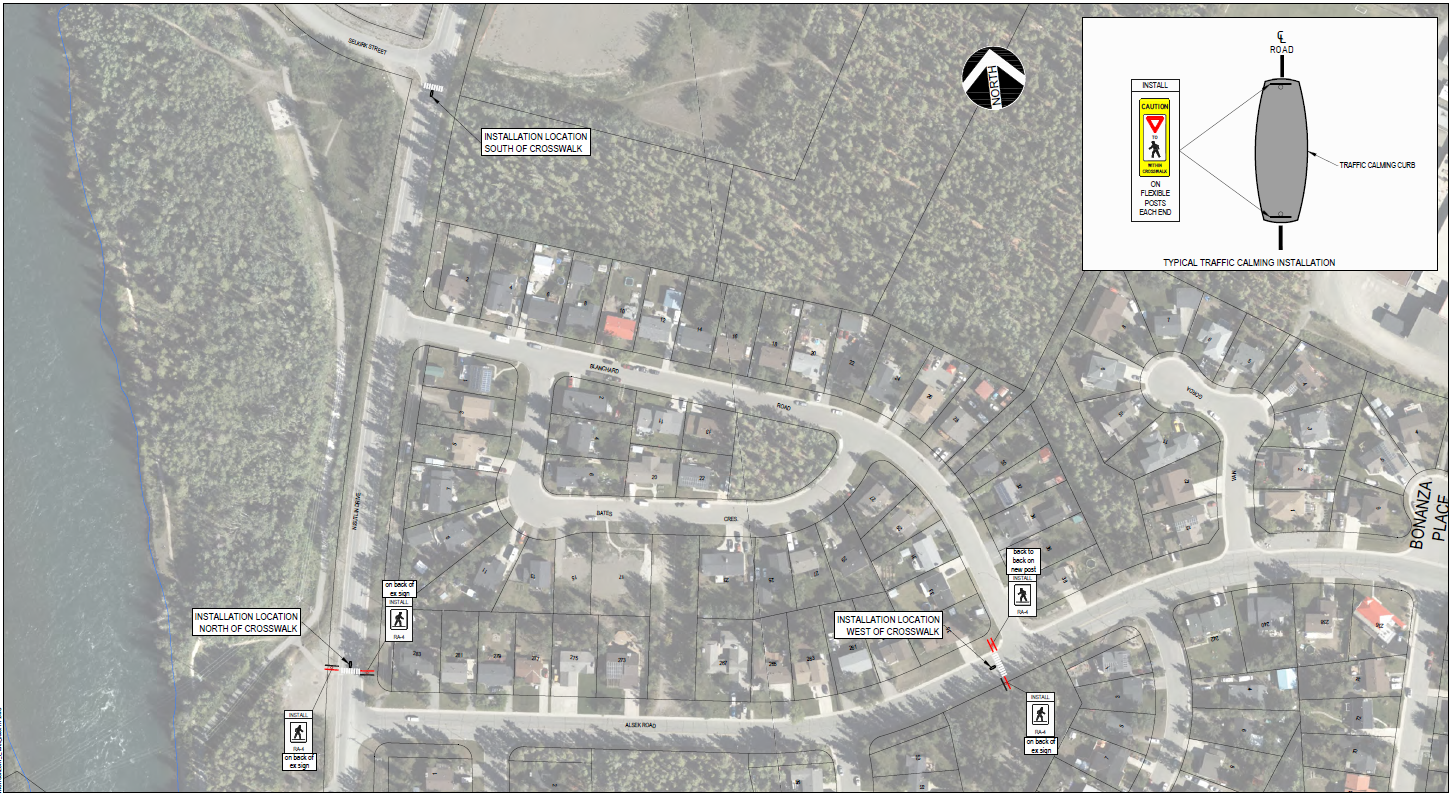
    These projects include the installation of traffic-calming (TC) curbs at crosswalks, achieving three goals:

    1. Narrowing the roadway to reduce driver speeds
    2. Providing a safe refuge for pedestrians crossing one direction of traffic at a time
    3. Creating space for additional signage


    Range Road
    Two TC curbs will be installed at the crossings at Falaise Road and Rhine Way.
    Nisutlin Drive and Alsek Road
    Three TC curbs will be installed at the crossings along Nisutlin Drive and Alsek Road.
    Speed Humps

    Speed humps are permanent raised features that encourage drivers to reduce speed. The design used by the City is based on a 40 km/h speed and does not impede snow clearing.

    Keewenaw Drive
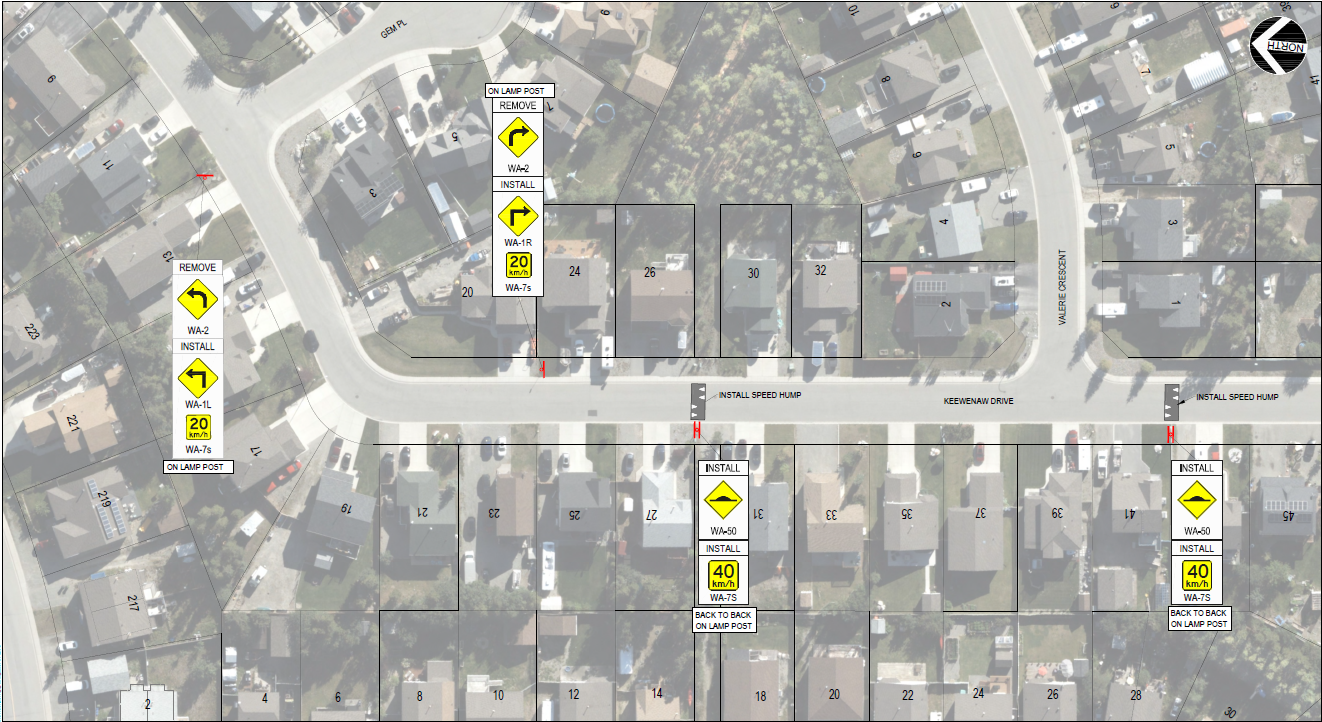
    Klondike Road
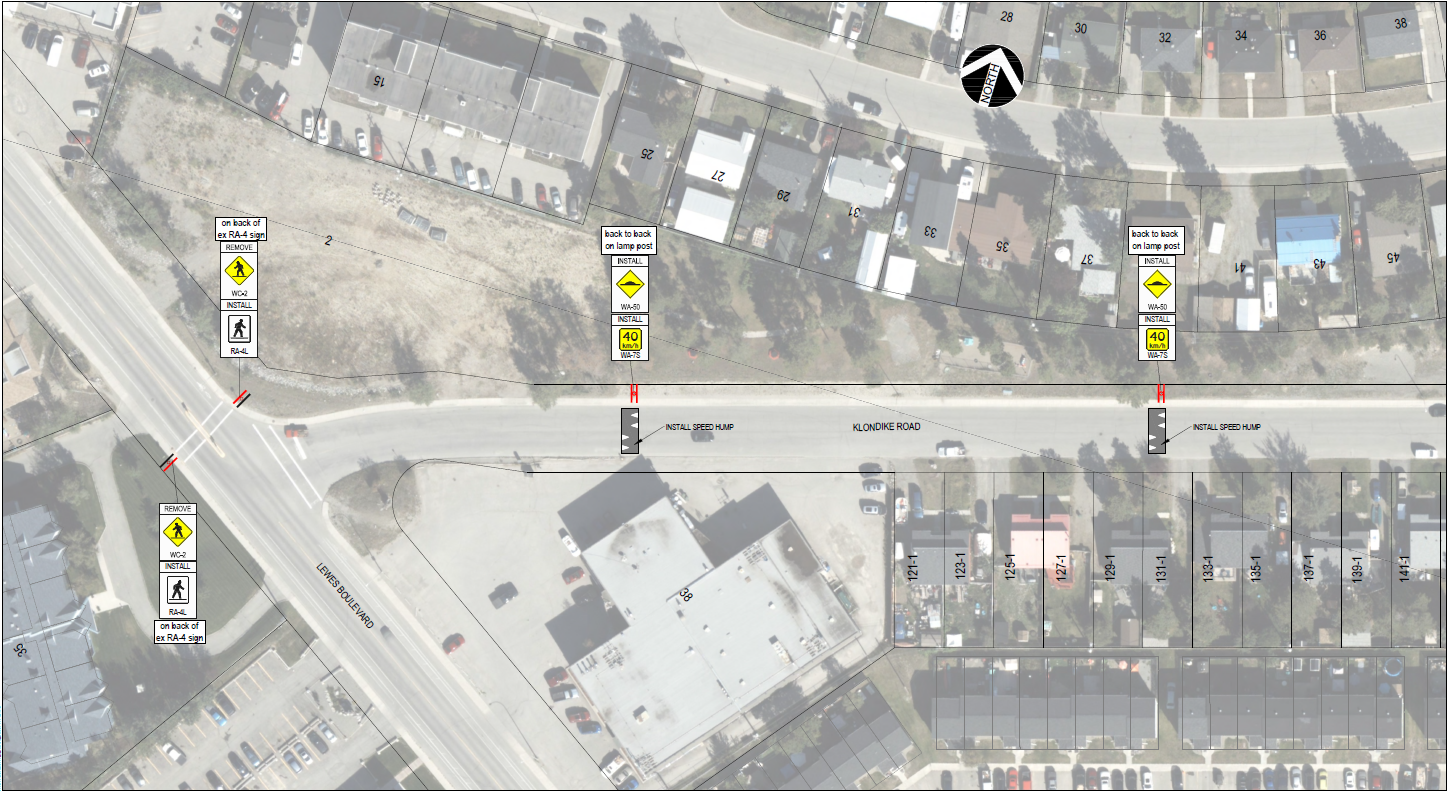
    Please note that the speed humps planned for Elm, Maple, and Oak were not installed last year due to contractor availability. During preparation of this year’s plan, these locations did not rank as highly under the new warrant evaluation. Current budget constraints do not allow for additional installations; however, seasonal measures will be implemented (see below).

    Speed feedback signs

    The City now has four speed feedback signs that can be deployed throughout the community. These signs are rotated between locations regularly, as their effectiveness can diminish over time when drivers become familiar with them. In addition to displaying vehicle speeds to encourage slower driving, the signs are also capable of collecting traffic data. However, they do not record any information that could be used for enforcement purposes.

    Some locations includes Hillcrest Dr, Leota St, Witch Hazel Dr, Sycamore St and Mt Sima Road.

    Country residential neighbourhoods improvements

    Transverse lines and painted “SLOW” markings will be added to encourage drivers to reduce speed in playground zones in country residential areas. The Transportation Association of Canada notes that this technique can reduce 85th percentile speeds by 5–15 km/h. Two new playground zone are added this summer at Harvey Rd and Salmon Trail.
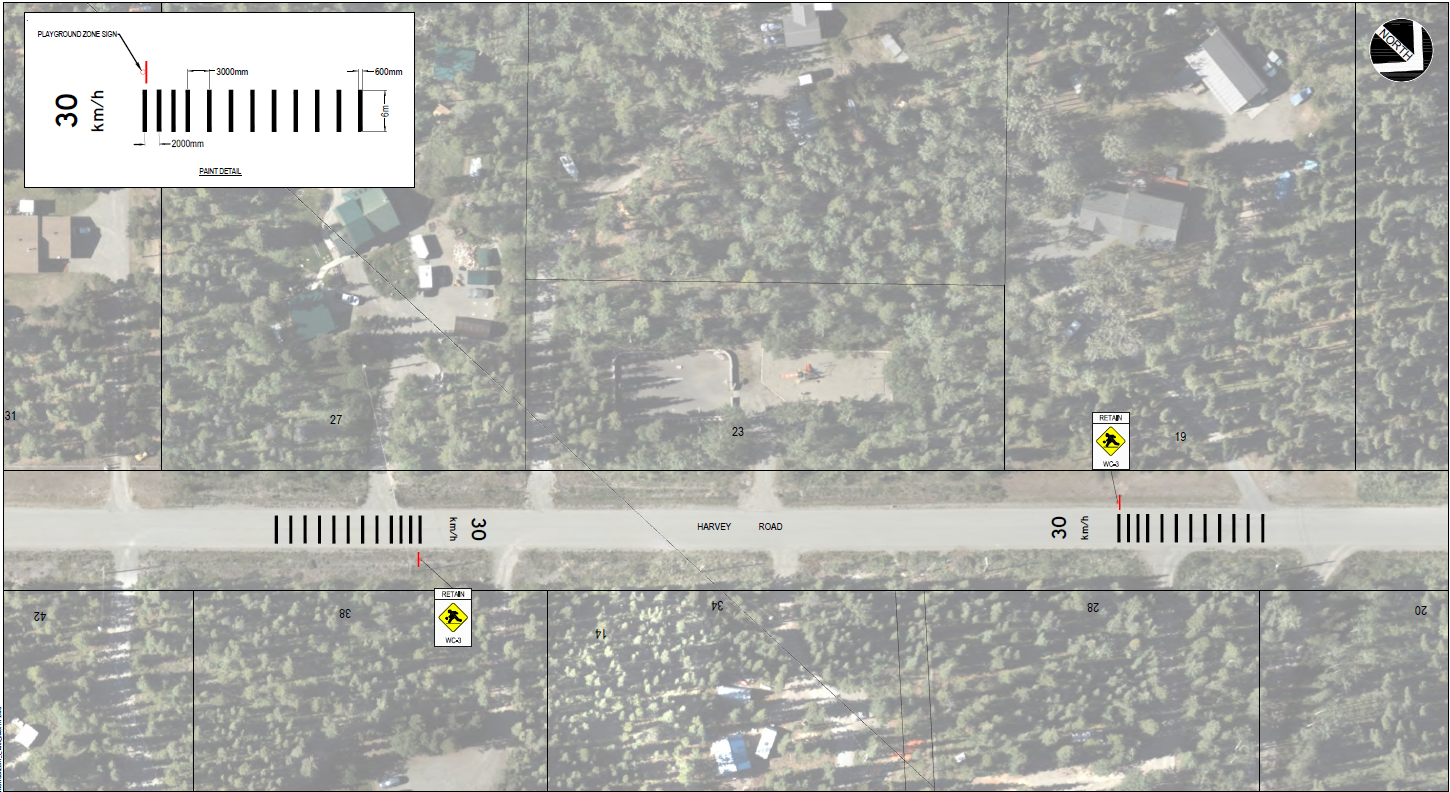
    "Watch for pedestrians" will be installed along access roads in country residential neighbourhoods to increase driver awareness and encourage lower speeds.

    SEASONAL MEASURES

    These measures will be in place starting in June and will be removed before the first snowfall.

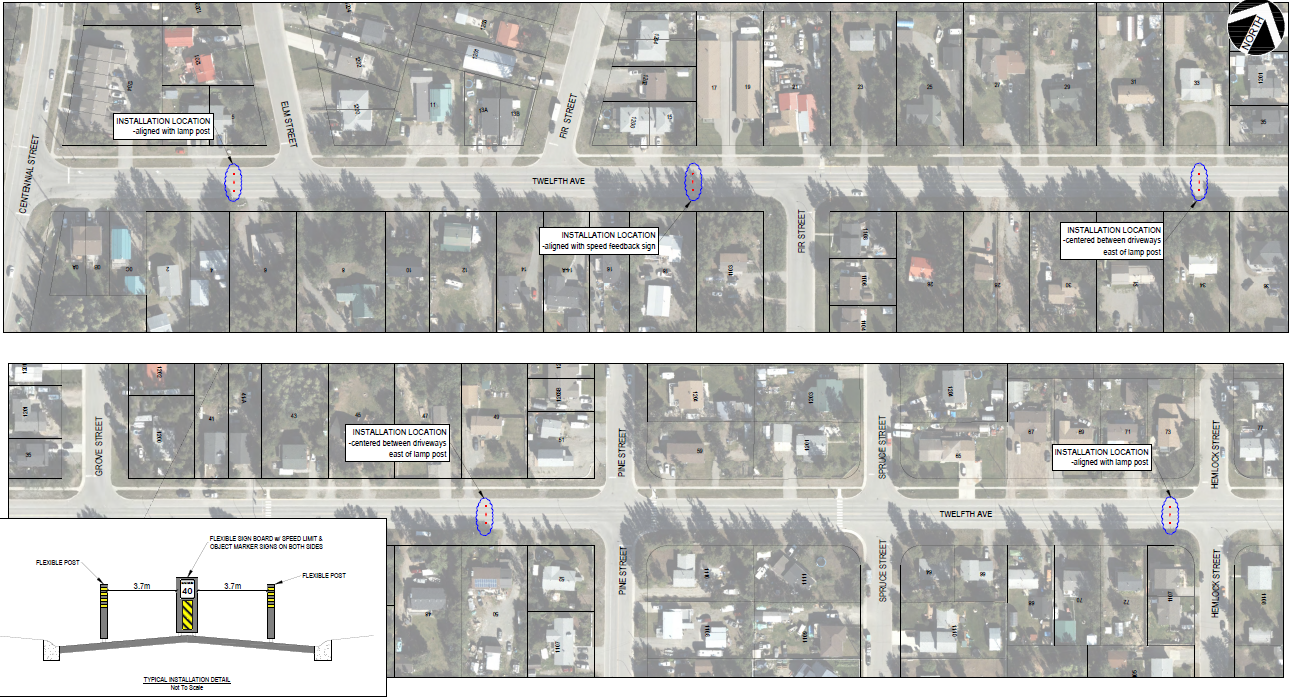
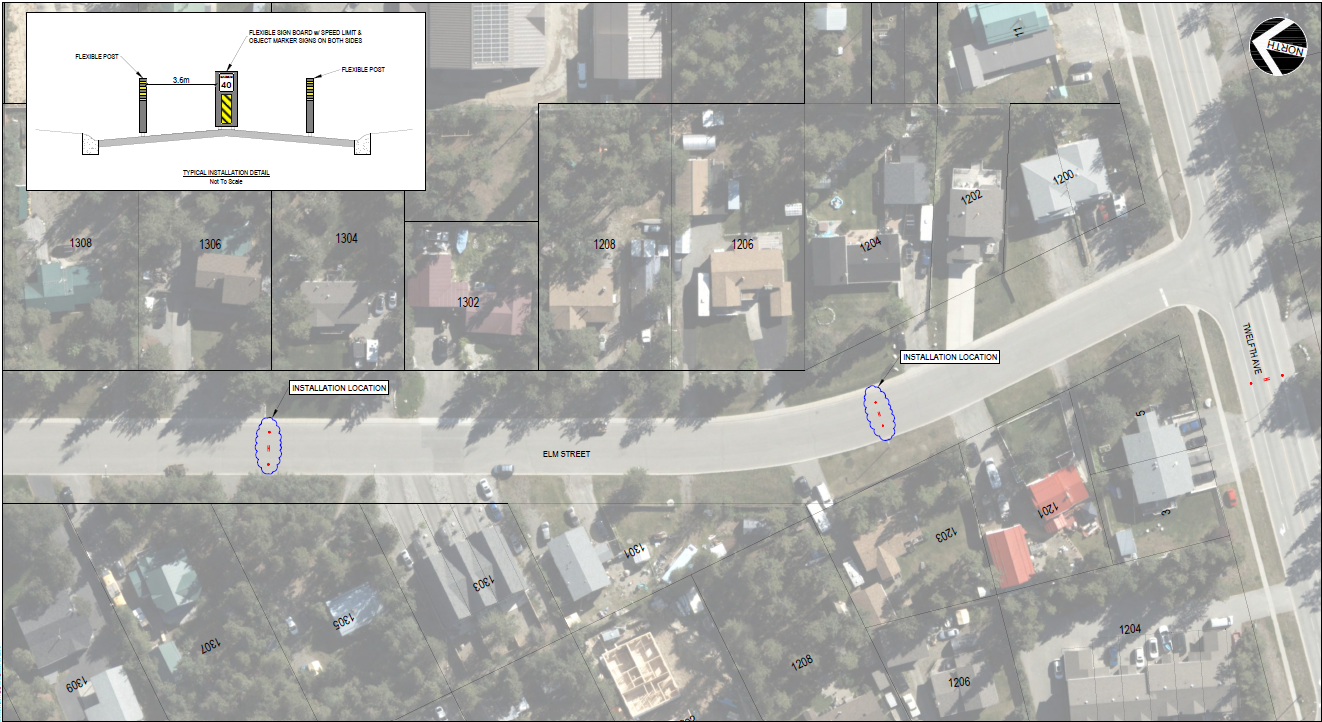
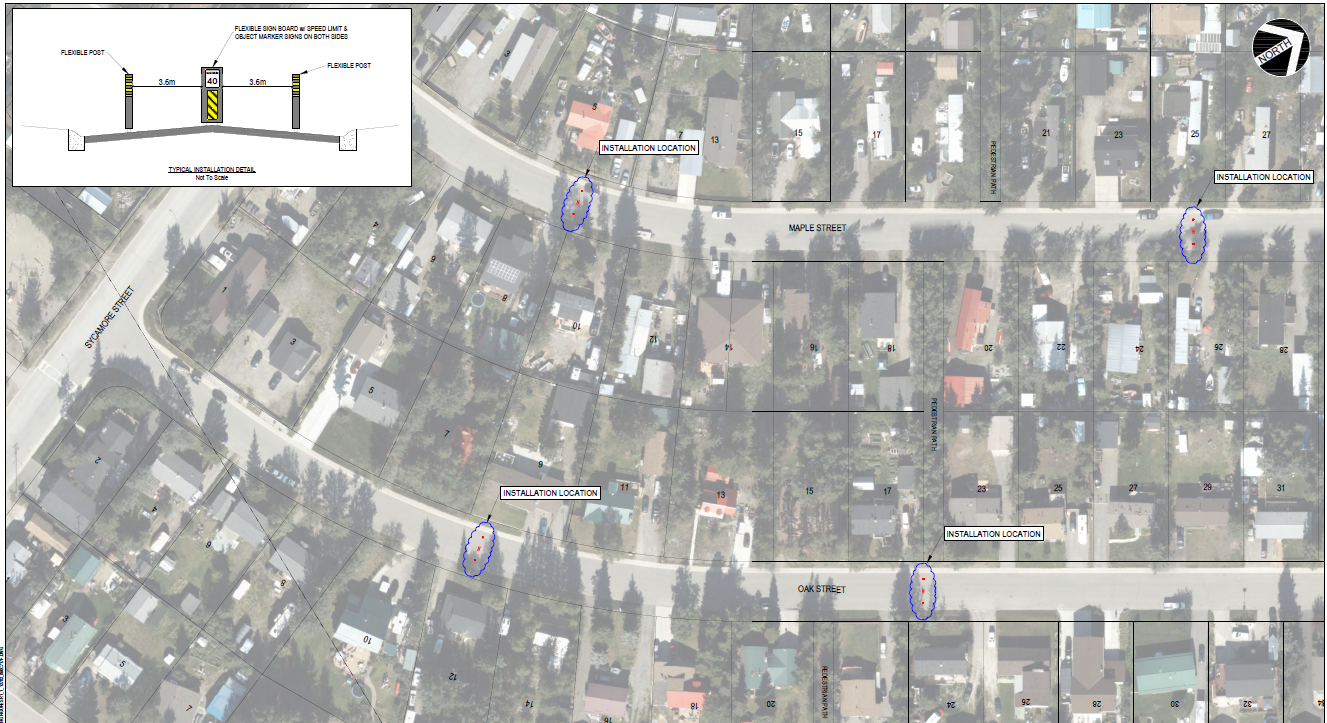
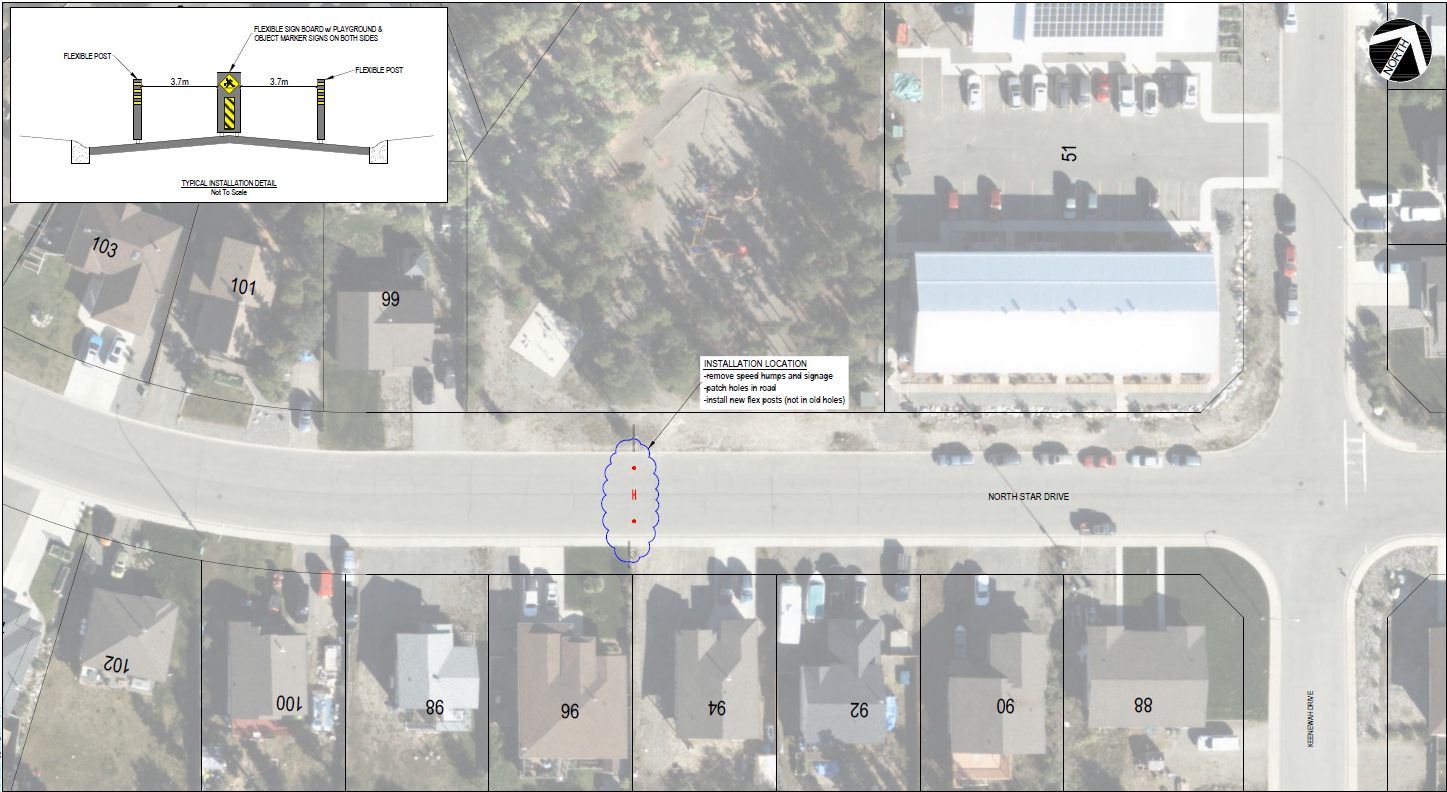
    Flexible bollards

    These flexible bollards are an effective tool used to narrow the roadway and are implemented across Canada. The installation involves anchors installed in the asphalt that will remain in place over the winter to allow for easier reinstallation the following spring. These measures are expected to return annually.

    12th Avenue
    Elm, Maple & Oak
    Playground zones (North Star Dr and Rainbow Rd)

    Kid Alert Sign Distribution

    The City is distributing Kid Alert signs you can place in your front yard to remind drivers to slow down and drive safely. Click here to request a Kid Alert Sign for free.


    The City has developed a new Traffic Calming Framework that outlines a process for residents to request traffic calming. Requests for traffic calming can be made through a new tool and are evaluated on a yearly basis. Requests received by September 30th of each year will be considered for implementation in the following construction season.

    Click here to request traffic calming.

    The 2026 locations were identified by analyzing areas of concern highlighted in the Transportation Master Plan, the Speed Limit Reduction Report and by residents. Speed and traffic data were collected to validate these concerns and to help determine the most appropriate calming measures for each location.

    YEAR-ROUND MEASURES

    Eugene Avenue South End Closure

    Eugene Avenue is a local road in Whistle Bend. Local roads are designed to allow residents to access their homes with minimal through traffic. Due to the roadway design of Whistle Bend, many drivers shortcut through Eugene Avenue, causing discomfort and safety concerns for residents. The City is expecting the closure to take place in early June and remain in place year-round.

    • Engineering assessments and public engagement were completed in 2024 to develop a traffic calming plan for Eugene Avenue. The final report is available here. The recommendation is to implement a cul-de-sac at the south end of Eugene Avenue.
    • The City temporary closure was piloted for 2 months last summer.
    • The design includes knock-down bollards for emergency access and jersey barriers.
    • Data collection is ongoing for Leota Street and Witch Hazel Drive.

    Pedestrian crossing refuges

    These projects include the installation of traffic-calming (TC) curbs at crosswalks, achieving three goals:

    1. Narrowing the roadway to reduce driver speeds
    2. Providing a safe refuge for pedestrians crossing one direction of traffic at a time
    3. Creating space for additional signage


    Range Road
    Two TC curbs will be installed at the crossings at Falaise Road and Rhine Way.

    Nisutlin Drive and Alsek Road
    Three TC curbs will be installed at the crossings along Nisutlin Drive and Alsek Road.

    Speed Humps

    Speed humps are permanent raised features that encourage drivers to reduce speed. The design used by the City is based on a 40 km/h speed and does not impede snow clearing.

    Keewenaw Drive

    Klondike Road

    Please note that the speed humps planned for Elm, Maple, and Oak were not installed last year due to contractor availability. During preparation of this year’s plan, these locations did not rank as highly under the new warrant evaluation. Current budget constraints do not allow for additional installations; however, seasonal measures will be implemented (see below).

    Speed feedback signs

    The City now has four speed feedback signs that can be deployed throughout the community. These signs are rotated between locations regularly, as their effectiveness can diminish over time when drivers become familiar with them. In addition to displaying vehicle speeds to encourage slower driving, the signs are also capable of collecting traffic data. However, they do not record any information that could be used for enforcement purposes.

    Some locations includes Hillcrest Dr, Leota St, Witch Hazel Dr, Sycamore St and Mt Sima Road.

    Country residential neighbourhoods improvements

    Transverse lines and painted “SLOW” markings will be added to encourage drivers to reduce speed in playground zones in country residential areas. The Transportation Association of Canada notes that this technique can reduce 85th percentile speeds by 5–15 km/h. Two new playground zone are added this summer at Harvey Rd and Salmon Trail.

    "Watch for pedestrians" will be installed along access roads in country residential neighbourhoods to increase driver awareness and encourage lower speeds.

    SEASONAL MEASURES

    These measures will be in place starting in June and will be removed before the first snowfall.

    Flexible bollards

    These flexible bollards are an effective tool used to narrow the roadway and are implemented across Canada. The installation involves anchors installed in the asphalt that will remain in place over the winter to allow for easier reinstallation the following spring. These measures are expected to return annually.

    12th Avenue

    Elm, Maple & Oak
    Playground zones (North Star Dr and Rainbow Rd)
    Kid Alert Sign Distribution

    The City is distributing Kid Alert signs you can place in your front yard to remind drivers to slow down and drive safely. Click here to request a Kid Alert Sign for free.


    The City has developed a new Traffic Calming Framework that outlines a process for residents to request traffic calming. Requests for traffic calming can be made through a new tool and are evaluated on a yearly basis. Requests received by September 30th of each year will be considered for implementation in the following construction season.

    Click here to request traffic calming.

  • Neighbourhood speed limit reductions coming into effect

    Share Neighbourhood speed limit reductions coming into effect on Facebook Share Neighbourhood speed limit reductions coming into effect on Twitter Share Neighbourhood speed limit reductions coming into effect on Linkedin Email Neighbourhood speed limit reductions coming into effect link

    Speed limits are being reduced to 40 kilometres per hour on many streets and roads in residential neighbourhoods throughout Whitehorse. The speed limit on Hamilton Boulevard between the roundabout at McIntyre Drive and the south end of Falcon Drive will also be reduced to 50 kilometres per hour.

    The new reduced speed limits come into effect when new signage is in place.

    Signs will be installed beginning this week with installation continuing throughout August and September.

    Installation will be done by neighbourhood in the following order:

    - Copper Ridge, Granger, Hillcrest, Logan, and Ingram

    - Riverdale

    - Porter Creek, Takhini

    Speed limits are being reduced to 40 kilometres per hour on many streets and roads in residential neighbourhoods throughout Whitehorse. The speed limit on Hamilton Boulevard between the roundabout at McIntyre Drive and the south end of Falcon Drive will also be reduced to 50 kilometres per hour.

    The new reduced speed limits come into effect when new signage is in place.

    Signs will be installed beginning this week with installation continuing throughout August and September.

    Installation will be done by neighbourhood in the following order:

    - Copper Ridge, Granger, Hillcrest, Logan, and Ingram

    - Riverdale

    - Porter Creek, Takhini, Range Point, and Crestview

    - Whitehorse North

    - Whitehorse South

    Drivers are asked to watch for new signage and follow the speed limits in place.

    This work is part of the Neighbourhood Speed Limit Reduction project approved by City Council in June. It builds on the 2022 Downtown Speed Reduction project that reduced speed limits downtown to 40 kilometres per hour.

    The Neighbourhood Speed Limit Reduction project will improve road safety for all users, and aligns with the City’s Transportation Master Plan and the safe mobility targets identified in the Official Community Plan.


    As per the City's Traffic Bylaw, the neighbourhood streets and roads that will have speed limits reduced to 40 km/h are as follows.

    Arkell

    Eagle Place, Falcon Drive, Grouse Crescent, Heron Drive, Loon Road, Ptarmigan Place, Sandpiper Drive

    Canyon Crescent

    Canyon Crescent

    Copper Ridge

    Adit Lane, Agate Court, Amethyst Trail, Aquamarine Place, Black Bear Lane, Carlisle Lane, Carnelian Court, Diamond Way, Drift Drive, Emerald Trail, Falcon Drive, Garnet Crescent, Gem Place, Grafter Place, Grizzly Circle, Iron Horse Drive, Keewenaw Drive, Kodiak Place, Lazulite Drive, Moonstone Lane, North Star Drive Olivine Place, Peridot Crescent, Pueblo Court, Pueblo Lane, Ruby Lane, Sapphire Lane, Spinel Place, Stope Way, Tigereye Crescent, Topaz Crescent, Turquoise Court, Valerie Crescent, Winze Lane, Zircon Lane

    Cowley Creek

    Chinook Lane, Chum Place, Coho Trail, Grayling Place, Kokanee Place, Pike Place, Sockeye Place

    Crestview

    Askin Place, Azure Road, Bryde Place, Cache Place, Crag Road, Dezadeash Road, Kathleen Road, Klukshu Avenue, Kusawa Road, Minto Road, Rainbow Road, Squanga Avenue

    Fox Haven

    Alusru Way

    Granger

    Bowen Place, Gilis Place, Hayes Crescent, Hayes Place, Salter Place, Tabor Crescent, Thompson Road, Turner Crescent, Williams Place, Williams Road, Wilson Drive

    Hidden Valley

    Cloud Berry Lane, Cranberry Place, Loganberry Lane, Mossberry Lane, Roderick Place, Soapberry Lane, Stehelin Drive, Strawberry Lane, Timothy Place

    Hillcrest

    Burns Road, Chalet Crescent, Dalton Trail, Hillcrest Drive, Kluane Crescent, Park Lane, Roundel Road, Summit Road, Sunset Drive North, Sunset Drive South, Wasson Place

    Ingram

    Goldeneye Place, Goldeneye Street, Mallard Way, Pintail Place, Pintail Street

    Logan

    Bluejay Way, Falcon Drive, Finch Crescent, Magpie Road, Nuthatch Place, Warbler Way, Wren Place

    MacPherson

    MacPherson Road (north of Marion Crescent), Marion Crescent

    Mary Lake

    Aster Place, Bluebell Place, Buttercup Place, Columbine Place, Crocus Place, Iris Place, Larkspar Place, Lupin Place, Marigold Place, Orchid Place, Sage Place

    Pineridge

    Castle Drive, Haldane Place, Harvey Place, Harvey Road, Keele Place, Logan Road, Nansen Drive, Tombstone Place

    Porter Creek

    11th Avenue, 12th Avenue, 13th Avenue, 14th Avenue, 15th Avenue, 9th Avenue, Alder Place, Alder Street, Almond Place, Aspen Drive, Balsam Crescent, Bamboo Crescent, Basswood Street, Birch Street, Boxwood Crescent, Cedar Crescent, Chestnut Place, Ebony Place, Elm Street, Evergreen Crescent, Fir Street (north of 12th Avenue), Gibbons Place, Grove Street (north of 12th Avenue), Grove Street (south of 9th Avenue),

    Hemlock Street, Hickory Street, Juniper Drive, Locust Place, Mulberry Place, Pine Street (north of 12th Avenue), Ponderosa Drive, Rosewood Place, Spruce Street, Stan McCowan Place, Tamarack Drive, Teak Avenue, Walnut Crescent, Willow Crescent, Yew Place

    Range Point

    Crow Street, River Ridge Lane, Swan Drive

    Raven’s Ridge

    Arctic Chief Place, War Eagle Way

    Riverdale

    Aishihik Road, Alsek Road, Bates Crescent, Bell Crescent, Blanchard Road, Bonanza Place, Boswell Crescent, Donjek Road, Duke Road, Firth Road, Green Crescent, Hart Crescent, Hyland Crescent, Ibex Street, Kalzas Place, Ketza Road, Klondike Road, Kluhini Crescent, Koidern Avenue, Lewes Boulevard, Liard Road, McQuesten Road, Morley Road, Nisutlin Drive, Peel Road, Pelly Road, Ross Road, Selkirk Street, Stewart Road, Tagish Road, Takhini Avenue, Tatchun Road, Tay Street, Teslin Road, Tutshi Road, Van Gorda Place

    Spruce Hill

    Engelmann Drive, Sitka Crescent

    Takhini

    Arleux Place, Cambrai Place, College Drive (University Drive), Dieppe Drive, Falaise Road, Normandy Road, Seine Square, Vimy Place

    Whistle Bend

    Aksala Drive, Alert Avenue, Atlin Place, Bailey Place, Bellingham Court, Breadwinner Lane, Caprice Court, Casca Boulevard, Chakawana Lane, Chance Lane, Dora Crescent, Eldorado Drive, Ellwood Street, Eugene Avenue, Evelyn Avenue, Flora Avenue, Fulton Lane, Gleaner Avenue, Goddard Way, Iditarod Lane, Iskoot Crescent, Keno Way, Leota Street, Luella Lane, Marathon Road, Mascot Street, Neecheah Street, Olive May Way, Omega Street, Quick Street, Rampart Avenue, Reliance Street, Sadie Lane, Scotia Lane, Skookum Drive, Sybil Circle, Tanana Lane, Tarahne Way, Tyrell Crescent, Vedder Avenue, Witch Hazel Drive, Wyvern Avenue

    Whitehorse Copper

    Cirque Place, Crevasse Crescent, Drumlin Crescent, Kame Court, Kettle Lake Place, Nunatak Place, Pingo Place, Serac Count, Tarn Court

    Wolf Creek

    Blaker Place, Harbottle Road (north of Boss Road), Langholz Road, Phelps Place, Ryder Place

  • Updated Neighbourhood Speed Zones Map

    Share Updated Neighbourhood Speed Zones Map on Facebook Share Updated Neighbourhood Speed Zones Map on Twitter Share Updated Neighbourhood Speed Zones Map on Linkedin Email Updated Neighbourhood Speed Zones Map link

    This map indicates the streets where speed limits have been reduced as part of the Neighbourhood Speed Limit Reductions project.

    The new reduced speed limits come into effect when new signage is in place. Signs are being installed one neighbourhood at a time. Follow the City of Whitehorse on social media for updates.

    You can view an interactive, zoomable map by clicking on the map below.
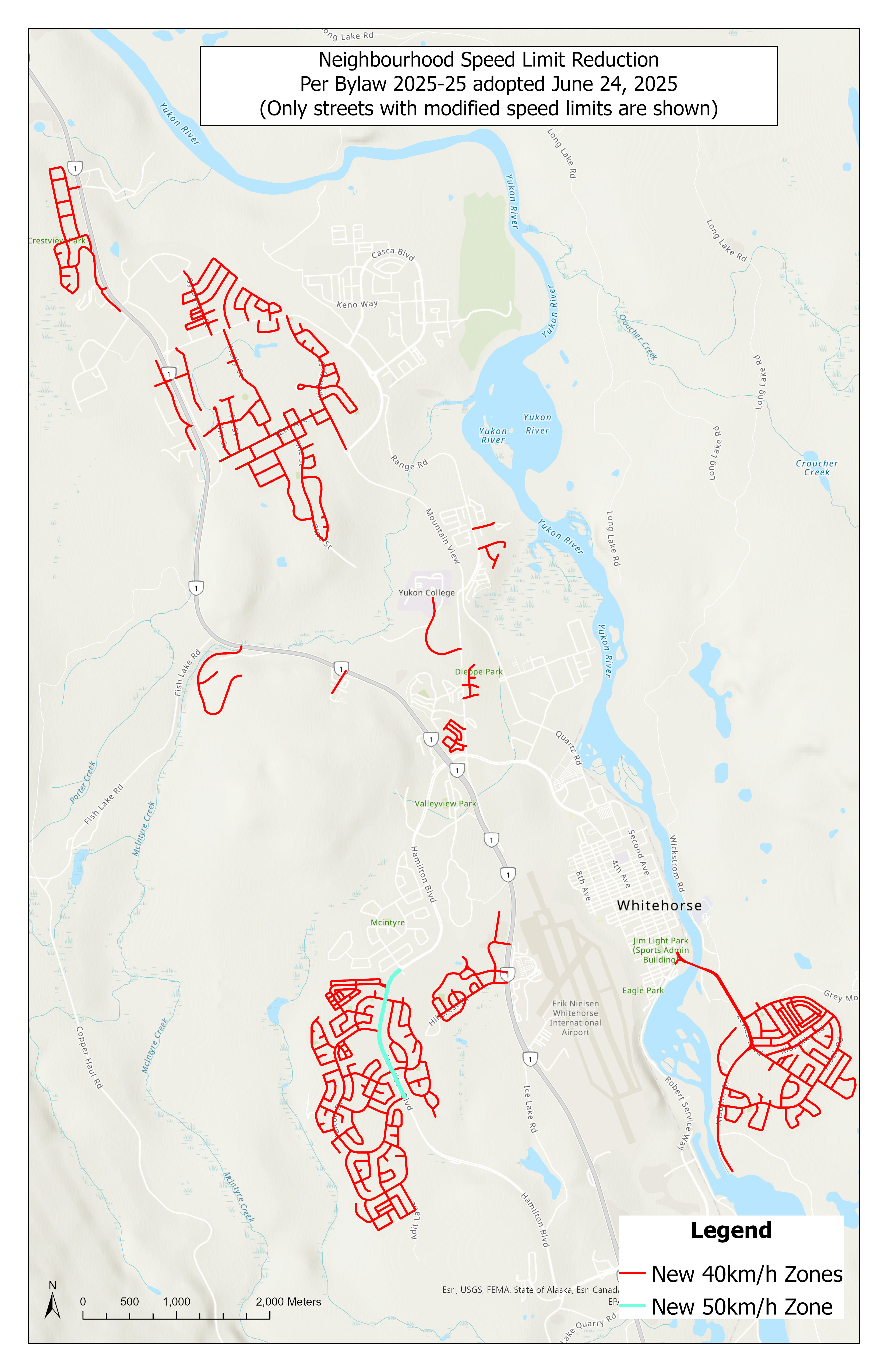
    This map indicates the streets where speed limits have been reduced as part of the Neighbourhood Speed Limit Reductions project.

    The new reduced speed limits come into effect when new signage is in place. Signs are being installed one neighbourhood at a time. Follow the City of Whitehorse on social media for updates.

    You can view an interactive, zoomable map by clicking on the map below.

  • Neighbourhood Speed Limit Reduction Final Report

    Share Neighbourhood Speed Limit Reduction Final Report on Facebook Share Neighbourhood Speed Limit Reduction Final Report on Twitter Share Neighbourhood Speed Limit Reduction Final Report on Linkedin Email Neighbourhood Speed Limit Reduction Final Report link

    Thank you to everyone who participated in the engagement process. We are now pleased to share the Final Report on Neighbourhood Speed Limit Reduction. The recommendations outlined in the report will help shape the implementation, scheduled for summer 2025.

    The City of Whitehorse identified a strong community desire to enhance the safety of the transportation network, especially within residential areas. Drawing inspiration from the Downtown Speed Reduction project, the main objective of this study was to establish a consistent approach to identify and implement safe and appropriate speed limits along residential streets in Whitehorse both in urban and rural neighbourhoods.

    The following key considerations were identified for speed limits in Whitehorse:

    • Speed and Injury Severity: The risk of serious injury or death for people walking and cycling increases significantly with increases in motor vehicle speeds.
    • Driver Behaviour and Built Environment: The design of streets impacts the behaviour of people driving, including how fast they choose to drive.
    • Urban vs. Rural: The context in urban residential neighbourhoods is different than country residential neighbourhoods.

    Based on the analysis, public engagement, and industry best practices, the recommended speed limits are as follows:

    Urban Residential Neighbourhoods:

    • 40 km/h on all local and collector streets except for Takhini North and Valleyview where the current 30 km/h speed limit will be retained.
    • Traffic calming has been identified for urban residential neighbourhood streets where the current design encourages higher driving speeds.
    • A select number of streets in urban residential neighbourhoods have been identified to be posted at 50 km/h because they function as collector or arterial roads that facilitate through movement.

    County Residential Neighbourhoods:

    • 40 km/h on local roads (aligning with urban neighbourhoods).
    • Access roads have been identified to remain at 50 km/h speed limits.
    • A limited number of roads have been identified for traffic calming to reinforce the reduced speed limit, particularly where drivers will be entering the lower speed residential streets directly from a highway.

    School and Playground Zones:

    • School and playground zones will remain posted at 30 km/h

    The rationale for the recommended speed limits is:

    1. Reducing residential speed limits to 40 km/h on local streets, collector streets, and local road (in country residential areas) progresses the City of Whitehorse along the path to Vision Zero*, implementation of the Safe System Approach and supports consistency and equity for all neighbourhoods.
    2. Data from Edmonton indicates a significant reduction in serious injury (25%) and fatal crashes (31%) following a change in speed limits to 40 km/h from 50 km/h.
    3. Public engagement indicates support for reducing speed limits and is consistent with favourable opinions of an initial reduction to 40 km/h supported by traffic calming.
    4. Reducing speeds to 40 km/h will allow the City of Whitehorse to deploy traffic calming on wider streets where compliance with lower speed limits may be challenging.

    *Vision Zero seeks to eliminate all traffic fatalities and serious injuries while promoting safe, healthy, and equitable mobility for all road users. The Safe System Approach is a framework to guide safe mobility policies and programs. It is a recognition that one traffic fatality or serious injury is too many. The City will be implementing a Vision Zero Policy in 2025.

    Thank you to everyone who participated in the engagement process. We are now pleased to share the Final Report on Neighbourhood Speed Limit Reduction. The recommendations outlined in the report will help shape the implementation, scheduled for summer 2025.

    The City of Whitehorse identified a strong community desire to enhance the safety of the transportation network, especially within residential areas. Drawing inspiration from the Downtown Speed Reduction project, the main objective of this study was to establish a consistent approach to identify and implement safe and appropriate speed limits along residential streets in Whitehorse both in urban and rural neighbourhoods.

    The following key considerations were identified for speed limits in Whitehorse:

    • Speed and Injury Severity: The risk of serious injury or death for people walking and cycling increases significantly with increases in motor vehicle speeds.
    • Driver Behaviour and Built Environment: The design of streets impacts the behaviour of people driving, including how fast they choose to drive.
    • Urban vs. Rural: The context in urban residential neighbourhoods is different than country residential neighbourhoods.

    Based on the analysis, public engagement, and industry best practices, the recommended speed limits are as follows:

    Urban Residential Neighbourhoods:

    • 40 km/h on all local and collector streets except for Takhini North and Valleyview where the current 30 km/h speed limit will be retained.
    • Traffic calming has been identified for urban residential neighbourhood streets where the current design encourages higher driving speeds.
    • A select number of streets in urban residential neighbourhoods have been identified to be posted at 50 km/h because they function as collector or arterial roads that facilitate through movement.

    County Residential Neighbourhoods:

    • 40 km/h on local roads (aligning with urban neighbourhoods).
    • Access roads have been identified to remain at 50 km/h speed limits.
    • A limited number of roads have been identified for traffic calming to reinforce the reduced speed limit, particularly where drivers will be entering the lower speed residential streets directly from a highway.

    School and Playground Zones:

    • School and playground zones will remain posted at 30 km/h

    The rationale for the recommended speed limits is:

    1. Reducing residential speed limits to 40 km/h on local streets, collector streets, and local road (in country residential areas) progresses the City of Whitehorse along the path to Vision Zero*, implementation of the Safe System Approach and supports consistency and equity for all neighbourhoods.
    2. Data from Edmonton indicates a significant reduction in serious injury (25%) and fatal crashes (31%) following a change in speed limits to 40 km/h from 50 km/h.
    3. Public engagement indicates support for reducing speed limits and is consistent with favourable opinions of an initial reduction to 40 km/h supported by traffic calming.
    4. Reducing speeds to 40 km/h will allow the City of Whitehorse to deploy traffic calming on wider streets where compliance with lower speed limits may be challenging.

    *Vision Zero seeks to eliminate all traffic fatalities and serious injuries while promoting safe, healthy, and equitable mobility for all road users. The Safe System Approach is a framework to guide safe mobility policies and programs. It is a recognition that one traffic fatality or serious injury is too many. The City will be implementing a Vision Zero Policy in 2025.

  • What We Heard: Traffic Calming Policy Engagement Summary Report

    Share What We Heard: Traffic Calming Policy Engagement Summary Report on Facebook Share What We Heard: Traffic Calming Policy Engagement Summary Report on Twitter Share What We Heard: Traffic Calming Policy Engagement Summary Report on Linkedin Email What We Heard: Traffic Calming Policy Engagement Summary Report link

    Thank you to everyone who participated in the Traffic Calming Policy survey. We are ready to share the What We Heard Report, which summarizes the community input received during survey.

    Thank you to everyone who participated in the Traffic Calming Policy survey. We are ready to share the What We Heard Report, which summarizes the community input received during survey.

  • What We Heard: Speed Reduction and Traffic Calming Public Engagement Report

    Share What We Heard: Speed Reduction and Traffic Calming Public Engagement Report on Facebook Share What We Heard: Speed Reduction and Traffic Calming Public Engagement Report on Twitter Share What We Heard: Speed Reduction and Traffic Calming Public Engagement Report on Linkedin Email What We Heard: Speed Reduction and Traffic Calming Public Engagement Report link

    Thank you to everyone who participated in the Champions Collaborative Initiative and the Road Safety Open House for the Neighbourhood Speed Limit Reduction and Traffic Calming project. We are ready to share the What We Heard Report, which summarizes the community input received during our engagement sessions.

    Thank you to everyone who participated in the Champions Collaborative Initiative and the Road Safety Open House for the Neighbourhood Speed Limit Reduction and Traffic Calming project. We are ready to share the What We Heard Report, which summarizes the community input received during our engagement sessions.

Page last updated: 04 Jun 2026, 01:33 PM